Once upon a time I used to blog about films all the time. But then I got fat and lazy and started having sex again and I pretty much threw my blog out the window so I could follow less noble pursuits. Well I’ve been feeling the itch lately and on top of everything else I’ve got AFI in a few weeks and I’d like to try and document the experience as I used to back in the good old days. So here I am, exercising my writing muscles.
These represent some of the more stream of conscious writing I’ve done but they certainly get the point across whether I fall on the “yay” or “nay” side of a film. This may be a rolling entry where I continue to add new titles or it may be the latest in a long-line of “one-off’s.” Either way, enjoy.
Changeling (2008 Clint Eastwood C) As has become Eastwood’s tradition with recent films, we get the studio logo at the head of the film in old fashion black and white, one would imagine harkening back to an earlier era of filmmaking where 70-something Clint might feel himself more at home. Who knew it would serve as a nifty metaphor for his distressingly limited world view? Essentially a Lars von Trier film without the irony or meta-context, here we get (a woefully miscast) Angelina Jolie in the Bjork-like role of the long-suffering woman crushed by a cruel, indifferent system while a host of TV actors including Jeffrey Donnovan using a distracting brogue, are trotted out as callous oppressors. Eastwood’s painting with a very wide brush here, never calling into question our heroine’s sanity, while simply presenting the LAPD as corrupt and lazy with no motivation beyond self-preservation. I mean was there nothing more to the entire scandal than a desire not to be publicly embarrassed? Actually the word “simple” seems the most apt adjective to employ here. Cheers for the wronged woman! Hisses for the evil institutions! Jolie murmurs and caterwauls her way to awards attention (she’s working from the Sean Penn playbook of parental suffering), Amy Ryan reprises a variation of the foul-mouthed hard-living working class character from Gone Baby Gone, John Malkovich is once again unable to disguise his Walken-like weirdness in a relatively normal character, and on it goes. To be honest, I’m not even sure what Eastwood is trying for here. Guess I’ll just have to look forward to Gran Torino.
Synecdoche, New York (2008 Charlie Kaufman B+) I understand the hatred towards this film but I think it’s misplaced. Complaints that it’s merely Kaufman chasing a rabbit up his own asshole are, frankly, several films too late. A couple days removed and I’ve already doodled out a handful of theories about the film: Is it a celebration of collaboration, with Hoffman’s ever-expanding merry troop following him blindly for decades, going to a place where their performances end up merging, superseding and defining their actual lives? Or is it an indictment of endless self-analysis from Hope Davis’ Lynchian in her omnipresence shrink to characters literally being able to stand back and look at how others would perform their lives (and in the most on the nose allusion, the film’s unending curiosity with human’s examining their own excrement)? Or for that matter is it anything more than a Buñuel -like head trip, creating small worlds within the confines of its own ellipses, never really pausing to explain itself or ground the film in an easy to place logic? I guess the point is that it doesn’t matter what reading you take (although I personally prefer the cautionary tale second one) because the journey is so surprising and lovingly melancholy. There’s elements of Southland Tales-type hubris on display but Kaufman admirably seems to have both hands on the wheel at all times even when the road we’re on is windy and opaque. This isn’t to say every gambit pays off; not by a long shot. Everything relating to Hoffman’s daughter is utterly baffling (and not helped by the curious casting of the nearly 40-year-old Robin Weigert), Kaufman’s patented preciousness (including a house that’s perennially on fire) can be a bit, um, suffocating. There’s also an inherent redundancy to the premise which can be patience trying (by my unofficial count there are four “real” funerals and an equal amount of staged ones). Still, I find myself returning to the film in my mind repeatedly, which I really could never say for Kaufman’s more widely accepted Eternal Sunshine of the Spotless Mind. Bonus: Emily Watson as Samantha Morton is perhaps the single funniest joke of the year.
Slumdog Millionaire (2008 Danny Boyle B) I’m prefacing this by saying that I’m overrating this, but only as it applies to my own scale. Most people will (and already do) like this a whole lot more than I did, which considering my disproportionate admiration for late-period Boyle (I’m even a pretty big Sunshine apologist) surprises no one more than myself. Which is a long convoluted way of saying that if I wasn’t such a Boyle fanboy I’d really nail this for being the facile and morally sanitized City of God (by way of Dickens) rip-off that it is. The star here is the setting (as it was in City) and Boyle’s joyous direction. When the film is divorced from its own dopey, high-concept premise it’s energetic and vital, casting a light on what still remains an under-documented third world culture. The film’s characters never really transcend their roles as ciphers (which isn’t to say the performances are bad by any means) so they’re often only as transcendent as the story they’re intertwined in. So, in summation, stuff with kids working as urchins for Fagin-like figure (complete with involuntary maiming) is riveting. Stuff with now adult characters working under the thumb of hazily defined mob boss plays like a bad FX show. Plus, as alluded to earlier, I’m not overly impressed with Simon Beaufoy’s gimmicky screenplay which makes the adorable mistake of confusing contrivance with destiny (then again Shyamalan’s been doing the same thing for the past decade and he comes from the same part of the world as this film, so maybe it’s a cultural thing). I’m willing to forgive how every question our hero is asked dovetails into a vignette explaining how he knew the answer but does it always have to come together in such a quaint and tidy bow? Eminently worth seeing though for the naturalistic child performances, Boyle’s zippy direction (there’s a fantastic early chase sequence through the streets of Bombay that puts to shame incoherent gibberish like the Bourne sequels) and Anthony Dod Mantle’s gorgeous photography which explodes in Technicolor hues of yellow, brown, read and green. It’s unfortunate that Pineapple Express co-opted M.I.A.’s “Paper Planes” this summer as the film features a heck of a sequence cut to it, the effect of which is mostly lost due to over-familiarity. Also, I hate to be “that guy,” but would it have killed them to just subtitle the whole thing?
Role Models (2008 David Wain B+) This is being compared to Judd Apatow, which really isn’t very fair. As far as I’m concerned Wain has been making me laugh for just as long (and with more regularity than) Apatow has and Rudd and Banks were in Wet Hot American Summer long before 40-Year-Old Virgin. As sell-out projects go, this might be without peer in melding formulaic high concept comedy (Wain and his co-writers came to the project late in development) with more scatological almost dada-inspired digression and grotesque characterizations. Sure, I could point out that once the plot kicks in you can anticipate every single dramatic beat about twenty minutes in advance and it all more or less ends up exactly where you would expect it to (complete with lessons learned and hugs). And yeah, the advertising for the film seems to highlight every dopey comedic set-piece and bit of broad physical comedy, but there’s a very good reason for that: everything else in the film is way too vulgar, angry or inside to ever put in a commercial. You’ve got Paul Rudd putting on a master class of passive annoyance and casual misanthropy. Snark has never been wielded with more laser specific precision which does wonders in cutting through much of the third act hokum that’s par for the course. And really, what more needs to be said about Jane Lynch who as a recovering coke addict turned community leader cheerfully over shares an increasingly horrifying back-story of degradation (there’s also a bit of business involving a hot dog bagel that’s so juvenile I feel like my driver’s license should be revoked for laughing at it). Plus, unlike Apatow, Wain can appreciate the comedic value of female nudity as well as male. I’m truly stunned something this acidic and angry even got greenlit. I suppose the best thing I can say for the film is I found myself annoyed at the density of jokes prevented me from hearing every third joke over my own laughter. Also, is Seann William Scott turning into a strong comedic actor or is he just blessed with exceptional taste in material (see also: The Promotion)? Who knew there was so much intentional comedic value in KISS?
Showing posts with label early review. Show all posts
Showing posts with label early review. Show all posts
Tuesday, October 28, 2008

Sunday, October 21, 2007
AFF Double Feature: Juno and Lars & the Real Girl
Same usual lack of depth as my mini-reviews only longer and less focused. Bonus!

Festival hype is an especially tricky barometer to gage as it’s based in a genuinely decent place; a want to promote something small and as yet unchampioned, usually with little regard for the backlash that’s sure to come once people are paying $11 to see a film at the mall. Being first out of the gate is always tricky and being first isolated from the rest of the world only clouds things further. After playing Toronto and Telluride last month, Juno, emerged as the year’s darling “indie” comedy, trumpeting the arrival of blogger cum stripper cum screenwriter Diablo Cody and a star-making performance from Ellen Page who's mostly known in the geek world for pretending to castrate Patrick Wilson in Hard Candy and running from the Juggernaut (bitch!) in X-Men 3. Even more telling, the film has been called this year’s Little Miss Sunshine, which personally carried as much excitement as something being hailed as this year’s Big Mac.
What a relief then that the hype is wrong. Or wait, does that make it right? Aside from sharing a distributor, Juno has nothing in common with Little Miss Sitcom. It’s a bold, honest, bracingly original film that balances acerbic wit and unfussy emotion better than any film since the heyday of James L. Brooks. The film actually works best as a companion piece (and I would argue, corrective) to this summer’s surprise hit Knocked Up, telling a similar story but from the point of view of the person who can’t walk away from their responsibility. What differentiates Juno, and ultimately makes it the far better film, is its willingness to explore the entire spectrum of anxiety found in being an unwed parent, even embracing the idea that simply creating life isn’t some biological gateway to becoming an inherently better person. The film refuses to engage in squishy sentimentality about the sanctity of life (if there’s an award for most abortion/miscarriage jokes in a film, Juno is the runaway winner), presenting an intelligent, clear-eyed and scathingly funny depiction of its main character’s predicament and the decisions she arrives at.
Of course the film isn’t all Planned Parenthood jokes. If there’s a central goal to Juno it’s to tear down the notion of what exactly constitutes family and how little the functional, nuclear gathering has to do with anything in the 21st Century. Page is beautifully paired opposite the great JK Simmons and Allison Janney as her father and step-mother respectively, in a dynamic is as refreshingly nurturing, yet unencumbered by bullshit as I’ve seen in ages. Simmons is gloriously oblivious yet true of heart even in his off moments while Janney is given an (admittedly by design) “you go girl/go fuck yourself” scene that would not only put Erin Brockovich to shame but could very well become a rally call for mothers and daughters everywhere.
Juno is truly egalitarian in spirit, embracing those it initially targets as disingenuous, slyly shifting our perceptions of its characters, specifically those played by Jason Bateman and Jennifer Garner. The film makes early, easy swipes at the class divide and Garner in particular comes across as a pinched yuppie gargoyle at the picture’s onset, yet once the film places these two characters in their respective boxes it proceeds to chip away revealing uncomfortably human places and fears and ultimately redemption. The film is so subtle in shifting the audience’s allegiances, the cumulative emotional impact, once it kicks in, is all the more unexpected and appreciated.
Juno was directed by Jason Reitman whose Thank You For Smoking was liked by many and loved by me. Juno is an even better film, building around the young director’s snickering sense of humor and gift for the visual non sequitur. The film’s direction doesn’t especially call attention to itself, yet it represents an important step in Reitman’s evolution as a filmmaker, striking a balance between sardonic and heart-tugging with the greatest of ease.
But in the end, the film’s success is credited to two women (appropriately): its star Page and its writer, Cody who, as the film progresses, become inseparable. Page cuts through Cody’s Chayefsky by way of the blogosphere dialogue with a buzz saw, never allowing the verbal dexterity of the character come across as overly amused with itself or posturing. Page plays the title character as wise beyond her years yet vulnerable with a sense of where she’s going but no idea how to get there. Cody meanwhile deserves all the credit in the world for not taking the easy path with this story, never wavering from its ideals or losing its spirit or voice. And what a voice. It’s too early to tell whether Ms. Cody will ever follow through on the promise of this film, but after only one feature the young writer (who for those who are interested, is a total sex-kitten knock-out in addition to being insanely talented) announces herself as one of the most unique talents currently working in film. And should she fail to ever match this level of success, we can all take comfort in knowing she’s created at least one gem. A

Lars and the Real Girl may forever be irrevocably linked to Juno as I watched them in immediate succession (a problem most people won’t have) which certainly does this film no service even if it does create an informative case of contrasts. While Juno is hyper-stylized—perhaps bordering on precious—in its telling, its emotions are grounded in an earthy, unmistakably genuine bedrock; its very irony protects it from growing treacly and when it does get genuinely heartfelt (and it does) it has the effect of a baby bird pecking through its hard outer shell. Lars and the Real Girl, by comparison, is firmly grounded in a plain-spoken, aesthetically sparse setting where people keep their emotions close to their vest and seem to be as impenetrable and still as the winter landscape that surrounds them (at times the film feels like a geographical cousin to Steel City). But emotionally the film’s a fraud, predicated on that fabled, affable Midwest temperament which in this instance, to quote Richard Roper (probably the first and last time I’ll ever do so), involves an entire small town “sublimating itself” to the whims of Ryan Gosling’s mumbling introvert. For a film that no doubt sees itself as generous and nurturing, I found it remarkably self-involved.
The film swaths itself in the protective blanket of being a fairy tale, a defense that’s rather en vogue at the moment (see TV’s “Pushing Daisies” which practically induces diabetic comas), yet the genre it most closely adheres to is the “therapy film” where we patiently (no pun) wait on a character to come to the emotional epiphany we’ve quietly been anticipating for about ninety minutes. The film is distressingly more Dr. Phil than Adam Rifkin, leaving aside any of the more provocative or obtuse kinks for what amounts to the story of a boy learning to say goodbye to his imaginary friend. The “character” of Bianca (which for those who can’t tell from the ads is one of those anatomically correct sex dolls that Stern used to have propped up in his studio) is not only accepted by the community in total and without exception, but actually becomes in demand and rather preoccupied with civic duties, inspiring jealousy in Lars (really this is the only interesting idea in the entire film). I’m probably in a real small minority in wanting to see the exploration of love between a man and an inanimate object, but it’s got to be a heck of a lot more engaging than treating the doll as a walking (er, sitting) metaphor for the character’s emotional paralysis to be cured away by the end of act three.
Part of the problem here may be Gosling himself who is suffocated by an impossible part, a predicament he surmounted in Half Nelson that only fueled his legend. It’s a mannered, mumbling Geoffrey Rush-like performance which doesn’t even begin to fill in the rather glaring character holes in the script. The film treats Lars as if he were Rain Man, a cuddly sick person to be protected, when in fact his behavior is flat out creepy and occasionally cruel.
Which is a shame as Gosling’s supporting cast is without exception pretty phenomenal. Collectively keyed into their surroundings and the speed of life where church and Sunday dinners are the most important part of the week, the cast is unshowy and quietly devastating. As the impetus behind the town’s Capra-esque level of self-delusion Emily Mortimer clings to the hope that through sheer and unwavering altruism she can liberate a man who’s too damaged to venture outside his front door. Also desperate to save Lars is Kelli Garner’s Margo, a mousy bundle of nerves and dashed hopes. I’ve never been much of a fan of Garner’s work in the past but her work here is devastating in only a handful of scenes, presenting someone every bit as damaged as Lars without the support system catering to her.
But the performer who walks away from Lars and the Real Girl demanding our attention is Paul Schneider, last seen in some of the more tiresome scenes of The Assassination of Jesse James, as Lars’ older brother and reluctant caretaker to Bianca. Putting on a master class of understatement and quiet desperation, Schneider plays a man who’s only recently come to believe he’s to blame for his brother’s dysfunction, a byproduct of his own youthful rebellion. Mortified by Lars’ behavior yet racked with the guilt that he may have created it, Schneider truly is his brother’s keeper. Only when he dances to the film’s incredulous tune does it ring true. B-
Festival hype is an especially tricky barometer to gage as it’s based in a genuinely decent place; a want to promote something small and as yet unchampioned, usually with little regard for the backlash that’s sure to come once people are paying $11 to see a film at the mall. Being first out of the gate is always tricky and being first isolated from the rest of the world only clouds things further. After playing Toronto and Telluride last month, Juno, emerged as the year’s darling “indie” comedy, trumpeting the arrival of blogger cum stripper cum screenwriter Diablo Cody and a star-making performance from Ellen Page who's mostly known in the geek world for pretending to castrate Patrick Wilson in Hard Candy and running from the Juggernaut (bitch!) in X-Men 3. Even more telling, the film has been called this year’s Little Miss Sunshine, which personally carried as much excitement as something being hailed as this year’s Big Mac.
What a relief then that the hype is wrong. Or wait, does that make it right? Aside from sharing a distributor, Juno has nothing in common with Little Miss Sitcom. It’s a bold, honest, bracingly original film that balances acerbic wit and unfussy emotion better than any film since the heyday of James L. Brooks. The film actually works best as a companion piece (and I would argue, corrective) to this summer’s surprise hit Knocked Up, telling a similar story but from the point of view of the person who can’t walk away from their responsibility. What differentiates Juno, and ultimately makes it the far better film, is its willingness to explore the entire spectrum of anxiety found in being an unwed parent, even embracing the idea that simply creating life isn’t some biological gateway to becoming an inherently better person. The film refuses to engage in squishy sentimentality about the sanctity of life (if there’s an award for most abortion/miscarriage jokes in a film, Juno is the runaway winner), presenting an intelligent, clear-eyed and scathingly funny depiction of its main character’s predicament and the decisions she arrives at.
Of course the film isn’t all Planned Parenthood jokes. If there’s a central goal to Juno it’s to tear down the notion of what exactly constitutes family and how little the functional, nuclear gathering has to do with anything in the 21st Century. Page is beautifully paired opposite the great JK Simmons and Allison Janney as her father and step-mother respectively, in a dynamic is as refreshingly nurturing, yet unencumbered by bullshit as I’ve seen in ages. Simmons is gloriously oblivious yet true of heart even in his off moments while Janney is given an (admittedly by design) “you go girl/go fuck yourself” scene that would not only put Erin Brockovich to shame but could very well become a rally call for mothers and daughters everywhere.
Juno is truly egalitarian in spirit, embracing those it initially targets as disingenuous, slyly shifting our perceptions of its characters, specifically those played by Jason Bateman and Jennifer Garner. The film makes early, easy swipes at the class divide and Garner in particular comes across as a pinched yuppie gargoyle at the picture’s onset, yet once the film places these two characters in their respective boxes it proceeds to chip away revealing uncomfortably human places and fears and ultimately redemption. The film is so subtle in shifting the audience’s allegiances, the cumulative emotional impact, once it kicks in, is all the more unexpected and appreciated.
Juno was directed by Jason Reitman whose Thank You For Smoking was liked by many and loved by me. Juno is an even better film, building around the young director’s snickering sense of humor and gift for the visual non sequitur. The film’s direction doesn’t especially call attention to itself, yet it represents an important step in Reitman’s evolution as a filmmaker, striking a balance between sardonic and heart-tugging with the greatest of ease.
But in the end, the film’s success is credited to two women (appropriately): its star Page and its writer, Cody who, as the film progresses, become inseparable. Page cuts through Cody’s Chayefsky by way of the blogosphere dialogue with a buzz saw, never allowing the verbal dexterity of the character come across as overly amused with itself or posturing. Page plays the title character as wise beyond her years yet vulnerable with a sense of where she’s going but no idea how to get there. Cody meanwhile deserves all the credit in the world for not taking the easy path with this story, never wavering from its ideals or losing its spirit or voice. And what a voice. It’s too early to tell whether Ms. Cody will ever follow through on the promise of this film, but after only one feature the young writer (who for those who are interested, is a total sex-kitten knock-out in addition to being insanely talented) announces herself as one of the most unique talents currently working in film. And should she fail to ever match this level of success, we can all take comfort in knowing she’s created at least one gem. A
Lars and the Real Girl may forever be irrevocably linked to Juno as I watched them in immediate succession (a problem most people won’t have) which certainly does this film no service even if it does create an informative case of contrasts. While Juno is hyper-stylized—perhaps bordering on precious—in its telling, its emotions are grounded in an earthy, unmistakably genuine bedrock; its very irony protects it from growing treacly and when it does get genuinely heartfelt (and it does) it has the effect of a baby bird pecking through its hard outer shell. Lars and the Real Girl, by comparison, is firmly grounded in a plain-spoken, aesthetically sparse setting where people keep their emotions close to their vest and seem to be as impenetrable and still as the winter landscape that surrounds them (at times the film feels like a geographical cousin to Steel City). But emotionally the film’s a fraud, predicated on that fabled, affable Midwest temperament which in this instance, to quote Richard Roper (probably the first and last time I’ll ever do so), involves an entire small town “sublimating itself” to the whims of Ryan Gosling’s mumbling introvert. For a film that no doubt sees itself as generous and nurturing, I found it remarkably self-involved.
The film swaths itself in the protective blanket of being a fairy tale, a defense that’s rather en vogue at the moment (see TV’s “Pushing Daisies” which practically induces diabetic comas), yet the genre it most closely adheres to is the “therapy film” where we patiently (no pun) wait on a character to come to the emotional epiphany we’ve quietly been anticipating for about ninety minutes. The film is distressingly more Dr. Phil than Adam Rifkin, leaving aside any of the more provocative or obtuse kinks for what amounts to the story of a boy learning to say goodbye to his imaginary friend. The “character” of Bianca (which for those who can’t tell from the ads is one of those anatomically correct sex dolls that Stern used to have propped up in his studio) is not only accepted by the community in total and without exception, but actually becomes in demand and rather preoccupied with civic duties, inspiring jealousy in Lars (really this is the only interesting idea in the entire film). I’m probably in a real small minority in wanting to see the exploration of love between a man and an inanimate object, but it’s got to be a heck of a lot more engaging than treating the doll as a walking (er, sitting) metaphor for the character’s emotional paralysis to be cured away by the end of act three.
Part of the problem here may be Gosling himself who is suffocated by an impossible part, a predicament he surmounted in Half Nelson that only fueled his legend. It’s a mannered, mumbling Geoffrey Rush-like performance which doesn’t even begin to fill in the rather glaring character holes in the script. The film treats Lars as if he were Rain Man, a cuddly sick person to be protected, when in fact his behavior is flat out creepy and occasionally cruel.
Which is a shame as Gosling’s supporting cast is without exception pretty phenomenal. Collectively keyed into their surroundings and the speed of life where church and Sunday dinners are the most important part of the week, the cast is unshowy and quietly devastating. As the impetus behind the town’s Capra-esque level of self-delusion Emily Mortimer clings to the hope that through sheer and unwavering altruism she can liberate a man who’s too damaged to venture outside his front door. Also desperate to save Lars is Kelli Garner’s Margo, a mousy bundle of nerves and dashed hopes. I’ve never been much of a fan of Garner’s work in the past but her work here is devastating in only a handful of scenes, presenting someone every bit as damaged as Lars without the support system catering to her.
But the performer who walks away from Lars and the Real Girl demanding our attention is Paul Schneider, last seen in some of the more tiresome scenes of The Assassination of Jesse James, as Lars’ older brother and reluctant caretaker to Bianca. Putting on a master class of understatement and quiet desperation, Schneider plays a man who’s only recently come to believe he’s to blame for his brother’s dysfunction, a byproduct of his own youthful rebellion. Mortified by Lars’ behavior yet racked with the guilt that he may have created it, Schneider truly is his brother’s keeper. Only when he dances to the film’s incredulous tune does it ring true. B-
Friday, September 21, 2007
Because People Are Lazy...
I'm getting comfortable with my ever-expanding (both in length and volume) mini-movie-reviews both as a (hopefully) useful guide for my readers as well as a way for cataloging my thoughts, so I'll probably keep at it at least through "Oscar Season." One film however that won't be getting this kind of treatment is Paul Haggis' In the Valley of Elah which I saw early in the summer. If you're interested in my thoughts on this pre-release version of the film, which I've been told is almost identical to what's playing in theaters (save for what I'm hearing is a truly horrendous Annie Lennox ballad over the end credits), then click the link below. I'll probably do the same thing for The Kingdom in a couple weeks so I can renew the latest round of arguments about why the film isn't (according to some people anyway) better than Miami Vice.
http://andrewdignan.blogspot.com/2007/06/valley-gall.html
http://andrewdignan.blogspot.com/2007/06/valley-gall.html
Wednesday, July 25, 2007
Bourne Again
Okay so first thing’s first: can anyone remind me what happened in the last one? All I can remember is Franka Potente driving a jeep off a bridge and the camera twitching uncontrollably like Katherine Hepburn on one of those vibrating benches that Stern is such a fan of. The Bourne Supremacy has been canonized in the past three years (just the other day a friend referred to it as “a masterpiece of the genre”) but I remember despising it, often with me fighting the urge to exit the theater and go vomit in a corner or at the very least track down some Dramamine post haste.
Actually I was about to go into an extended rant on why Supremacy didn’t work for me but I realized I said it best on my (defunct) Geocities page so I’ll just reprint the choice excerpts below. I’ll be back in a minute:
…this is really a failure. An ambitious failure mind you, but ultimately an unmitigated one, with every single scene rife with glaring missteps and fatal miscalculations by all parties involved. Put bluntly, Greengrass is a hack (I was thoroughly unimpressed with his horrifically over-praised Bloody Sunday) relying upon the same stylistic crutch he used in his previous film. While the first film evoked the films of the cold war with its use of wide angles, long takes, artfully choreographed blocking and an overall jazzy tone that set the mood for the perfect summer film, Bourne 2 finds the filmmakers striving for portent and manufactured pathos, and involves a visual scheme just this side of epileptic (there's a word for critics who bag on Michael Bay's editing while applauding Greengrass' slash-and-hack approach here: they're called hypocrites). Plot is largely inconsequential, as I suspected the filmmakers had developed amnesia somewhere between Naples and Berlin, and the action (including the much heralded climactic car chase) is lacking any kind of emotional tangibility or spacial[sp] coherence. Frankly, I cared less and less about the film with each passing minute
--July 23, 2004
And I’m back. If I could just make a couple of less knee-jerk observations with three years removed from my disappointment, I’d say my opinion of director Paul Greengrass has softened somewhat. The hack label was unfair, and while I’ll never respond to it in the way its champions do, I don’t think anyone could have made a better film of United 93. I think Greengrass is a serious filmmaker who’s got a lot more on his mind than frivolous summer fun and he lends a lot of weight to a series which really started out as a Cold War lark.
I tend to over-praise Liman’s first Bourne film, but there was almost a “Gee whiz” sense of discovery to the character; something about the whole amnesia angle and Damon’s apple-cheeked performance. It was the ultimate little boy fantasy: what if you woke up tomorrow and you were a killing machine on the run from the government? The direction was crisp and clean and simple, and really allowed you to appreciate the incredible stunt work. Long, fluid camera movements that really capture the excitement of watching someone do what they’re great at (they being both Bourne and the action coordinators).
Greengrass, as a citizen of the world, seems a lot more interested in fall-out and the effect these back-office black-ops have not only on their victims but the men and women whose job it is to execute them. It was so angsty and unpleasant and annoyed at the world half the time I thought the camera was shaking because Greengrass was kicking it in frustration. But remove the overused “this time it’s personal” angle and there was really nothing holding the film together. Bourne is pissed. Bourne is under attack. Bourne brings the fight to your door. The plotting existed more to move Bourne from one foreign locale to another (again not a bad thing per say, Bond does the same thing) but Greengrass seemed intent on sapping all of the fun out of the entire endeavor.
I can’t quite pinpoint exactly why I liked The Bourne Ultimatum so much more than Supremacy as it contains many of the same issues, especially the same problematic tendencies from Greengrass. Greengrass directs action the way Baz Luhrman directs dancing; lots of quick cuts and artificial energy without any real sense of what’s happening and where. There’s a brutal hand to hand combat scene in the film’s Tangiers sequence that’s sure to get a lot of attention but I was mostly irritated at how close and tight Greengrass places the camera. It’s like watching two Olympic judo champions from three inches away; we know what they’re doing is spectacular but there’s not enough distance to appreciate it.
Greengrass repeats this visual scheme throughout this film but the result is less detrimental I *think* because there’s more to the film than simply Bourne’s white hot rage at his former employers. For starters, Bourne has been given a truly worthy antagonist in David Strathairn’s deputy director. Strathairn’s character is cut from the same entitled, starched, white beaurocrat mode who’s not above getting his hands dirty. Joan Allen who was fine in the last film was ultimately too professional and “decent” to really hammer home the threat so this film wisely places her in the role of Bourne’s uneasy ally. The film finds Bourne looking inward, desperate to find the men who made him what he is (much of this material reminded me of Wolverine’s past in the X-Men series) only to find he’s more complicate in his behavior than he’d like to believe.
The film has genuine appreciation for the skill of tactics and one-upmanship, with each side covertly moving against the other. While the film is shockingly violent at times its most riveting sequences are those where we see Bourne anticipating several moves ahead of everyone else, such as an early sequence involving a series of phone calls and a busy train station. While I think Greengrass tends to distort our perspective too much in the action sequences, you do get the sense you’re watching a chess game being played.
But mostly the film returns some of the fun to the story. It still pushes the characters into some dark waters but the film itself retains the propulsive energy one would expect from a film opening in the first week of August. The thing fucking cooks; even when it’s unclear what direction we’re heading in there’s no downtime to get worked up over it. Plus (and this is a big one) it certainly compares favorable to most of the summer’s big event films. The series ultimately got away from where I wish it would have gone, but it’s more or less as it should be in the end. Plus, factor in everyone on Earth loved Supremacy except for me so whatever my enthusiasm is for this one, figure yours will be up exponentially.
Friday, June 8, 2007
A Mighty Heart
Don’t let the existence of this blog entry fool you: I have astoundingly little to say about this film. It’s an average procedural in almost every regard that’s elevated by arguably the first great performance of Angelina Jolie’s career. Looking back, Jolie’s one of those performers who’s famous even though no one really likes any of her films (she’s essentially the female equivalent of Colin Ferrell), but this may be the first great movie star performance of her career, ironically so as director Michael Winterbottom is doing everything in his power to dispel the notion. Filmed in scatter-shot, handheld digital, Jolie is often placed at the edge of the frame, her face turned away from the camera as if she’s shielding herself from our rubber-necking. When Marianne Pearl retreats to her room to rage against Danny’s killing, her animalistic wails are a slap in the face to Oscar-clip ready emoting and the concept of tidy, cinematic mourning.
More than just crying on cue though Jolie nails the stubbornness and righteous indignation of the character that won’t allow her the time to pity herself. It’s hard to think of a character in this position coming across as unlikable but what the film does is refuse to place the character in the role of the victim until there’s absolutely nothing left to be done, allowing her to lash out and be human while living under a microscope. This is quietly strong work with the character serving as the taciturn center for the flurry of investigators and family friends that circle around and bounce off of her. The years spent working for the UN and cultivating Noah’s ark of third world children have served the actress well; her moral authority shines through in every scene.
The rest of the film could have benefited from Jolie’s conviction. Framed by Marianne’s narration (at one point even speaking to the fact that we’re watching a film) the film can’t help but come across as a movie of the week (even its very title smacks of Lifetime). Winterbottom borrows more than a few visual touchstones from Michael Mann, but lacks the latter’s propulsive style or poetic digressions. Furthermore, the entire film is dedicated to the idea of watching a woman confront impending doom, teasing out when the hammer above her head will finally fall. And unlike such films as United 93 or Letters from Iwo Jima where the filmmaker is given the opportunity to expand upon a confusing or alien period of our national history, there’s really little to tell beyond the dimming hope with each passing day of Pearl safe return. I’m sure this story needed to be told, I just don’t know that I needed to see it.
Tuesday, June 5, 2007
Valley Gall
Question of the day:
If Paul Haggis directs a film and it’s only half the train wreck that Crash was, should I be encouraged or disappointed?
I’m not going to get into too much Haggis bashing here as, by the time Crash won a stunning best picture victory over heavy favorite Brokeback Mountain last year, you’d have sworn the guy was a WWII conspirator who hated puppies and democracy instead of the director of a terrible and inexplicably awarded film. Haggis is part of a long tradition of cinema as diatribe, which some have confused as social consciousness. Regardless, no matter how flawed the final results invariably have been, I can’t deny that it springs from a source of good intention and a misguided belief that one film can change the world.
There’s also the issue that Haggis, an affable fellow by all outward appearances who even poked fun at himself in an "Entourage" episode, has written or co-written some of the best films to come out in the past few years, particularly his work with Clint Eastwood (it’s easy to forget how beloved Million Dollar Baby is even with the most hardened of cynics in the wake of Crash) and last year’s Bond revival Casino Royale. The problem is Haggis tendencies as a writer usually err on the side of pat characterizations and cute, Syd Field-ian storytelling devices that better filmmakers have the common sense to barrel right over whereas Haggis the director seems to wallow in them.
Haggis’ latest film In the Valley of Elah (Warner Independent, due in September) is not an awful film because it lacks the ambition and delusions of grandeur required to be an awful film. The film finds Haggis narrowing his scope from (in all capital letters) LIFE AND RACE IN L.A. to a rather intimate procedural that makes clumsy if predictably toothless swipes at the war in Iraq before an embarrassingly gooey (and poorly telegraphed) denouement. Essentially this is “A Few Bad Men” with Tommy Lee Jones channeling a Paul Schrader protagonist as he leaves the safety of his Middle America cocoon to investigate the murder and mutilation of his son near a southern military base, where he finds the U.S. military in full-on, cover its own ass mode.
It’s actually not a bad idea (albeit a fairly derivative one) and Tommy Lee’s given a plum part as a Vietnam vet and military lifer who's so ramrod straight that he remakes his hotel bed to comply with military standards and would rather grab a wet shirt out of the dryer than be seen in his undershirt by someone of the opposite sex. Jones has been playing variations on ornery and crotchety for thirty-years now but he gets some wiggle room here, finding humor in the understated, plainspoken demeanor of the character. More interesting is his losing battle with his own rage and slow realization that the son he’s pushed into a life in the military may not be the boy he sent off to war.
The problem with the film is it’s trying to be all things to all people with no one particular element executed especially well. Partnered with Jones’ character is Charlize Theron (in mousy earth-tones) whom the film dedicates an inordinate amount of time to as the female homicide detective who may or may not have slept her way into the department and must now prove her worth to her loutish male colleagues (and yes, maybe even to herself). If you put a gun to my head, I swear I couldn’t come up with a subplot in film history less interesting, yet the film keeps cutting away from its central mystery (hell, even leaving its rather vague thematic safety net of “war is hell”) to dwell on Charlize and her father-less son, Charlize the conflicted cop, Charlize the department doormat getting her grove back, etc…
Furthermore, once the film establishes the Jones’ kid is legitimately dead (the way the body is presented, I half expected him to show up in the third act) the guilty parties are readily apparent simply by virtue of what type of film this is, making the string of red herrings thrown in our path utterly transparent. I’m weary of condemning the film too heavily because issues with the film’s languid pacing will likely be addressed in the next few months (almost half the questions on the survey spoke to film length and scenes that may or may not have dragged), but it’s doubtful even with judicious editing they’ll be able to cut around the series of “A-ha!” revelations. What I gather is meant to be a stirring indictment of sociopath disassociation ends up coming across as warmed over Abu Ghraib bedtime stories, made all the more annoying by the fact that the film’s delivery system of each withering indictment of war is through one of the lamest devices imaginable (let’s just say when you’re fighting in a war it’s probably doubtful you’re going to be running the video function on your cell phone while providing a play-by-play narration during each skirmish and insertion).
But the larger issue here, albeit one that doesn’t reveal itself till the final act, is the self-congratulatory tone which elevated Crash from the level of good-intentioned but naïve to abhorrent and smug grandstanding. Jones’ character fought in Vietnam yet he seems oblivious to the idea of war crimes, torture, and Post-Traumatic Stress Disorder, spending much of the film as the proverbial babe in the woods who’s shaken to the core but what he learns what the boys are doing over there while “spreading democracy.” Haggis is too canny a fence-sitter to lay blame on the soldiers themselves, essentially waving the white flag (as it were) at the whole concept of war, distilling his entire message down to “the whole situation’s fucked” which is exactly the sort of empty rhetoric that can generate lazy swells of applause without actually engaging with the overriding problem.
Is this really what a Hollywood liberal views as a wake-up call for Middle America, with Tommy Lee the last Red-Stater to finally get the message? In the Valley of Elah isn’t the blunt instrument swung in the name of shallow discourse that Crash was but the motion of the swing is every bit as clumsy.
Saturday, April 14, 2007
When did Peter Berg become a better filmmaker than Michael Mann?

An intentionally inflammatory headline, and not entirely accurate, but it’s worth exploring if only in the “what have you done for me lately” vein. At 43, Berg is a relatively young man to have already directed four features, all the more impressive when you consider he worked as a successful character-actor for almost ten years before making 1998’s sophomoric, but loved in some circles, “dark comedy” Very Bad Things. Since then Berg directed the underrated The Rundown which has the dubious distinction of being the only film in history where The Rock and Arnold Schwarzenegger share screen time together and the well-liked Friday Night Lights which has spawned a critically adored television show that he also executive produces.
An impressive start to what should prove to be a long and fruitful journeyman director’s career and yet the film that may ultimately prove to be the most important harbinger to his career up till now is 2004’s Collateral, a film where Berg remained entirely in front of the camera (he played Mark Ruffalo’s straight-laced cop buddy). It was at some point during this production that Collateral director-producer Michael Mann entrusted Berg to take over the reins of a project he’d been eye-balling, staying on as a producer and securing the budget and enormous amount of resources required to bring this story to the screen.
In many ways, The Kingdom is the film Miami Vice should have been and will likely attract the audience members that avoided Vice when it’s released into theaters this fall. Berg has shaped this film very much in the mold that Mann has been cultivating for nearly thirty years and if the final results lacks the artistry and grandeur of Mann’s best films it’s a fair sacrifice for the level of immediacy and white-knuckle tension that The Kingdom generates.
 Mann’s influence is impossible to miss in the film, from the casting of Jamie Foxx as another meticulous authority figure operating by his own code (he may ultimately become more associated with wearing sunglasses than even Nicholson) to the way the camera seems to burrow into its subjects, often framing the actors in tight close-up, just off-center and over the shoulder. The film—which to mine eyes, does an astounding job of faking the Arizona desert for Saudi Arabia—makes use of oppressive daylight, filming the majority of its bravura set-piece with the sun hanging unforgiving high in the sky. Predominantly shot on 35mm, as day gives way to night, Berg shoots exteriors in high definition video giving an otherworldly quality to what is already an alien terrain (when one American character asks for a description of their latest assignment they’re told it’s “a bit like Mars.”) Even Berg’s use of Explosions in the Sky as the temp music score (sadly to be replaced by a likely generic, Syriana-esque Danny Elfman composition) is the sort of boldly anachronistic choice that mirrors Mann’s own soundtrack selections ranging from Tangerine Dream in Thief to Elliot Goldenthal’s minimalist, percussion work on Heat.
The Kingdom values atmosphere and professionalism over clarity and character, at times flattening the incidental “how’s” and “why’s,” spitting out exposition as if it were a chore to be done with as quickly as possible. The result can be somewhat disorientating on the viewer, yet the absolutely confidence on display by both the performers and the filmmakers is somewhat assuaging. The overall sensation is one of understanding that we’re merely tagging along and the important thing is the people with badges and guns know what they’re doing.
Ultimately the film is about “the job” with emotion largely held in check save brief exchanges to mourn fallen comrades. Mann’s swooning romanticism and lyrical silent exchanges (in many ways, Mann has developed into the Wong Kar Wai of the loud guns and fast cars set) are absent here, and so too is anything in the way of character. With the exception of Foxx, the Americans in The Kingdom are afforded one personality-trait a piece (apart from their default setting of “badass”), which, in the case of poor Jennifer Garner, is the habit of sucking on lollypops during tense moments. The trailers for the film give off a distinct “C.S.I.: Riyadh” feel, which isn’t exactly wrong. The film is a procedural at heart, only one that’s thankfully less interested in forensics nuts and bolts, but rather in exploring the cultural divide between western interests and the Islamic Fundamentalism violently attempting change the course of the region.
What ultimately gives the film its strength, and perhaps pushes the film into a questionable moral quagmire, is the way it preys upon U.S. fears of the Middle-Eastern man. The film’s professionalism and discipline extends not only to the men and women of the FBI sent to investigate a horrific crime (the details of which I’m intentionally omitting), but to those fighting a holy war where there’s no concept of collateral damage or innocent bystanders. Like all great suspense films, the specter of violence looms as heavy as the violence itself, with seemingly every corner and darkened-doorway threatening to conceal a suicide bomber or rocket-propelled grenade launcher. The film plays upon our CNN-addicted culture, staging scenes meant to evoke everything from Al-Qaeda execution videos to Black Hawk Dawn.
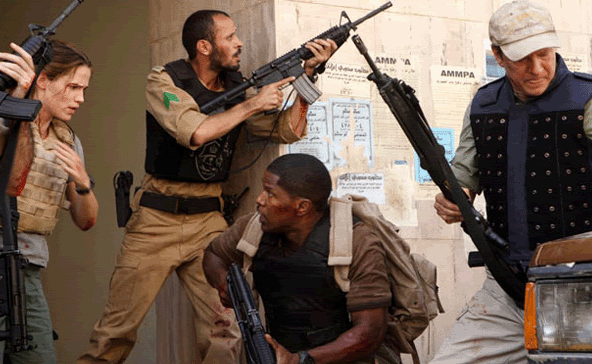 Bin-Laden is name-checked here as the film studiously tries to place its fictional events within a very real setting and context (there’s a fantastic opening credit sequence which serves as a USA Today style timeline to strife in the region). It’s the sort of film where you’ll probably find yourself leaning over to the person next to you and asking “did this really happen?”
Those who felt squeamish watching waves of minorities mowed-down in Black Hawk Down are likely to feel similar pangs of unease here. Although less jingoistic than the Ridley Scott film, The Kingdom poses the question “why do they hate us?” but isn’t especially interested in answers, rather it keeps the film’s Muslim assailants at arm’s length where they remain faceless boogie-men; appearing at will, attacking women and children with homemade bombs packed with C4 and nails. Accusations that the film is alarmist or even bigoted are not entirely without merit and may ultimately be its cross to bear.
The film gives Foxx’s character an indigenous police officer (Ashraf Barhom) with which he can butt heads and, ultimately, earn the respect and friendship of. The character is something of a screenwriter’s dream, forced to carry most of the film’s thematic weight while enduring withering glances and constant peril for being an Arab forced to aid and protect white infidels. Yet Barhom’s performance keeps the character from becoming a cipher, humanizing not only Foxx but the film itself. The character’s strong instincts and dedication to the work is the unifying factor which supersedes nationality and religion here; those who show up everyday and kickass without fuss are easily invited into Mann and Berg’s brotherhood.
As an action film The Kingdom is a curious beast. Too talky and observant to provide a rollercoaster ride for impatient genre fan, the film is however constructed around two elaborately staged action sequences at its book-ends that intensify slowly and steadily long before they snap in place like a bear-trap. What’s so remarkable though is how these sequences continue to build to terrifying heights, waiting for the audience to poke its head out after the smoke has presumably cleared, only to toss a hand grenade (literally) into the fox hole. It’s tempting to compare the latter of these two sequences to the now infamous “Battle of Bexhill” scene in Children of Men, matching that scene in duration and intensity (if not in ingenuity) as we follow our characters from a roadside attack to a courtyard RPG-evading shoot-out, to the claustrophobic confines of an apartment complex over the course of a break-neck twenty-five minutes.
Written by Matthew Michael Carnahan, The Kingdom is ultimately too schematic for its own good. A subject this messy shouldn’t tie itself up in such neat little thematic bows and there’s far too much “Syd Field-ian”, screenwriting 101 on display. Berg’s direction possesses far too much tunnel-vision to abide by such clumsy attempts at social commentary and unifying image-systems (it’s the sort of film where we endure a mawkish scene early on involving an adult and a father-less young boy only for it to be repeated in the third act in a different setting). From a momentum stand-point, the film doesn't so much crest as it does run into a brick wall, perhaps a victim of its own success.
The film is ultimately less than the sum of its parts but oh what parts they are. Scheduled for release in late September, the film is, in many ways, the perfect fall film. Adult and exhilarating, The Kingdom is taut like a really good airport-bookstore novel. There are quibbles to be found but they’re secondary to the realization that you’ve just dug your nails into the palm of your hand or that the air has slowly crept out of you lungs because you’re too tense to breathe. More importantly, it announces the arrival of Berg as an upper-echelon filmmaker who can operate comfortably on a large scale. Berg may only be emulating Michael Mann’s worldview here but, in essence, he’s re-appropriated it and stripped it down to only its most essential elements.
-----------------------------------------
NOTE: This is an early review of a work-in-progress. As a filmmaker, I respect the test-screening process as an important tool and, in general, believe an artist should be allowed to complete a piece of work before it’s appraised. I publish this review then as a rare breach of this agreement because I feel a) no one’s really going to care about a crappy upstart blog and b) what I’ve written is so overwhelming positive and effusive with praise for the film that it can only benefit from me banging the drum. This is what you call semantics.
Subscribe to:
Posts (Atom)